
MEDICARE, EXPLAINED
Medicare Part D
The coverage that helps pay for your prescriptions.
Original Medicare covers a lot, but it mostly leaves out your everyday prescriptions. Medicare Part D fills that gap. It's prescription drug coverage, sold by private insurers that Medicare approves.
Part D is mainly for people who kept Original Medicare. If that's you, a standalone Part D plan sits right alongside your Part A and Part B and covers your prescriptions. If you chose a Part C plan instead, your drug coverage is usually already built in, so you likely don't need a separate plan.
What Medicare Part D Covers
-
Prescription Drugs
The everyday medicines you pick up at the pharmacy and take at home, both brand-name and generic. This is the heart of Part D. If your doctor writes it and your plan covers it, this is what helps pay for it.
-
Insulin at a Set Price
If you use insulin, your cost is capped at a low, steady amount each month. You don't have to meet a deductible first, so the price is the price from day one. For anyone managing diabetes, that steadiness makes budgeting a lot easier.
-
Recommended Vaccines
Common shots, including the shingles vaccine, are covered at no cost to you. These used to run a couple hundred dollars out of pocket. Now the ones your doctor recommends are free under Part D.
-
A Yearly Spending Cap
There's now a limit on what you'll pay for covered drugs in a year. Once you reach it, your plan pays 100 percent of your covered prescriptions for the rest of the year. This protection is new, and for anyone on expensive medications, it's a big one.
-
Mail-Order Convenience
Many plans let you get a three-month supply of your regular medications by mail. It often costs less than picking them up one month at a time, and it saves you the trip. A small thing that adds up over a year.
What Medicare Part D Won’t Cover
Part D is built for the medicines you take at home, so a few things fall outside it.
Drugs given to you in a hospital or a doctor's office aren't covered here. Those belong to Part A or Part B, depending on where you get them. It's a common mix-up, and knowing the line ahead of time saves a surprise later.
Each plan also covers a specific list of drugs, called a formulary. If a medication isn't on your plan's list, the plan usually won't pay for it. This is the single most important thing to check before you choose a plan. Bring your current prescriptions and make sure they're covered. If one isn't, there are ways to request an exception, but it's far easier to pick the right plan from the start.
A few everyday things sit outside Part D entirely. Over-the-counter medicines, vitamins, and supplements aren't covered, even the ones your doctor suggests. And just like your doctors, pharmacies come in networks, so using one on your plan's list will usually cost you less.
Enrollments and Costs for Medicare Part D
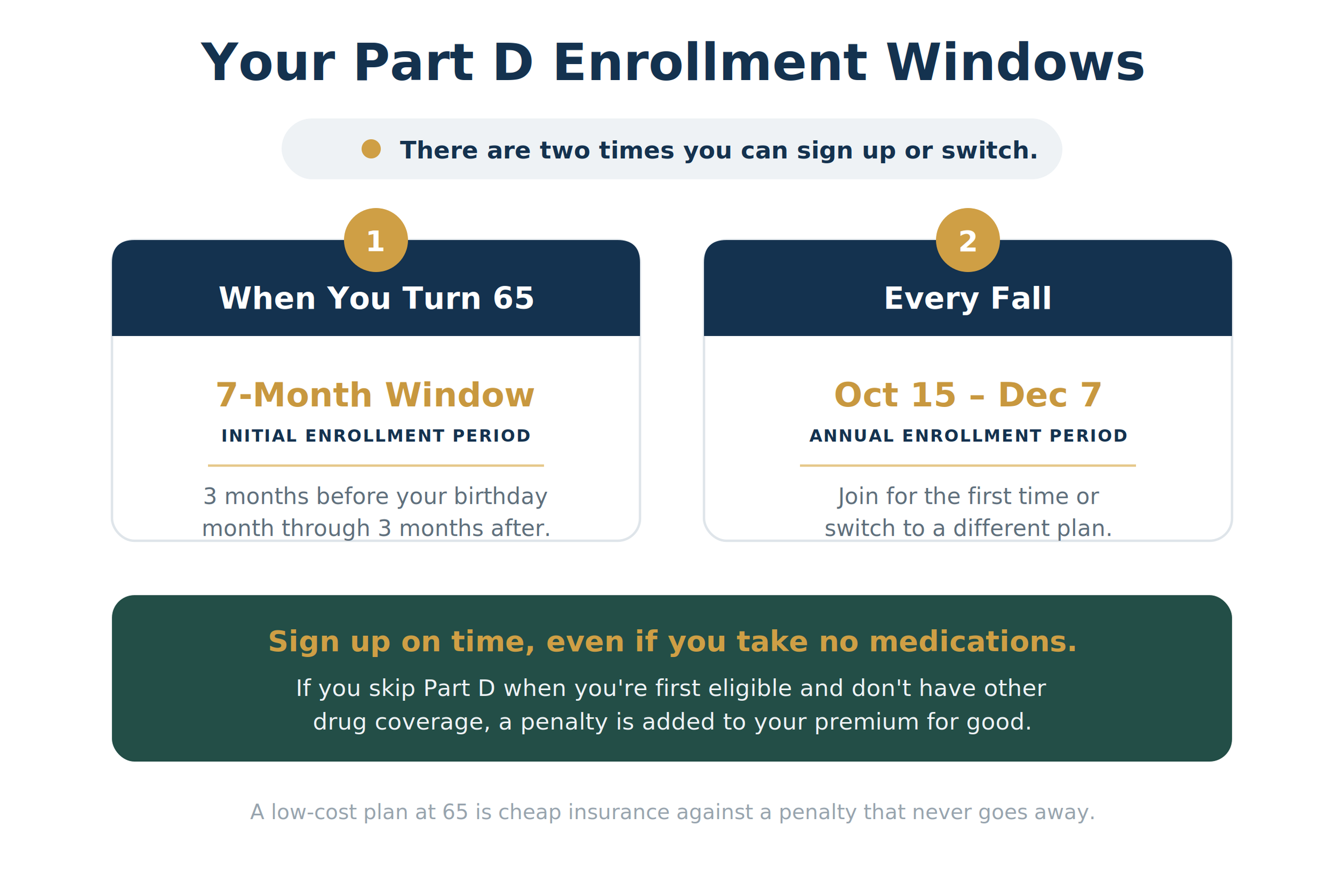
Enrollment: You have two main chances to sign up for Part D:
When you first turn 65. You get a seven-month window, starting three months before your birthday month and ending three months after.
Every fall, October 15 to December 7. This is when anyone can join a plan for the first time or switch to a different one for the year ahead.
A word of warning worth reading twice. Part D is optional, but if you skip it when you're first eligible and don't have other drug coverage, you can get hit with a late penalty when you finally sign up. That penalty is permanent. It gets added to your monthly premium for as long as you have Part D. This is why many people enroll in a low-cost plan at 65 even when they barely take any medications. It's cheap insurance against a penalty that never goes away.
What It Costs: Most Part D plans have a monthly premium, and it varies from plan to plan. Some plans have a yearly deductible and some don't. After that, you pay a share of each prescription until you hit that yearly cap, and then your plan covers the rest. The lowest premium isn't always the lowest total cost, because it depends on which drugs you take and what your plan charges for them. We can look at your actual medications and find the plan that covers them for the least, so there are no surprises at the pharmacy counter.
Medicare Part D FAQs
Do I need Part D if I don't take any prescriptions?
1
Usually yes, and here's why. If you skip it when you're first eligible, you can owe a permanent penalty later, even if you were healthy the whole time. Most people sign up for a low-cost plan at 65 to lock in coverage and avoid that penalty down the road.
Is there a limit on what I'll pay for drugs each year?
2
Yes, and this is new. Once your out-of-pocket spending on covered drugs reaches the yearly cap, your plan pays 100 percent of your covered prescriptions for the rest of the year. For years there was no ceiling at all, so this is real protection for anyone on costly medications.
Can I get Part D with Original Medicare?
3
Yes. You can add a standalone Part D plan alongside your Part A and Part B. That's the route for people who kept Original Medicare rather than choosing a Part C plan.
Every plan covers its own list of drugs, so the fix is to check that list before you enroll. If a medication you need isn't on it, you can either choose a different plan that covers it or ask your plan for an exception. The easiest path is picking the right plan from the start.
What if my medication isn't covered?
4
What is the late enrollment penalty with Part D?
5
It's an extra amount added to your monthly premium if you go without drug coverage after you were first eligible to get it. It's small each month, but it's permanent, so it grows the longer you wait. Signing up on time is how you avoid it.
Still Have Questions?
Medicare comes with a lot of details, and it's normal to have questions along the way. That's exactly what we're here for. Reach out anytime, whether you're just starting to look into your options or trying to sort out a specific decision. There's no cost to the conversation, and no obligation attached to it.