
MEDICARE, EXPLAINED
Medicare Part C
All your coverage, bundled into one plan.
Original Medicare comes in separate pieces. Part C, also called Medicare Advantage, puts them into one plan.
It's run by a private insurer that Medicare approves. It covers your hospital and doctor visits, usually your prescriptions too, and often adds extras like dental and vision. One plan. One card. One number to call. That's the appeal for a lot of people.
What Medicare Part C Covers
-
Hospital & Medical Care
Your hospital stays and your doctor visits are both covered under one plan. That includes the care you get when you're admitted and the everyday visits, tests, and treatments you have along the way.
-
Prescription Drugs
Most Part C plans include your prescription drug coverage built right in. That means one plan handles your medications along with the rest of your care, and one card covers it all.
-
Dental, Vision & Hearing
Original Medicare doesn't cover routine dental, vision, or hearing, but most Part C plans do. These everyday needs add up, and having them covered makes a real difference.
-
Fitness and Wellness
Many Part C plans include extras designed to help you stay healthy and active. A gym membership is one of the most common, and some plans add wellness programs, discounts, or classes.
-
A Yearly Spending Cap
Part C sets a yearly limit on how much you pay out of your own pocket for covered care. Once you reach that limit, the plan covers the rest for the year, so a serious health year can't keep costing you without end. Original Medicare has no limit like this.
What Medicare Part C Won’t Cover
Part C keeps things simple, but that simplicity comes with a trade. These plans work through networks, so each one has its own list of doctors and hospitals you're expected to use. Part C plans come in two main types.
An HMO plan keeps you within one network and usually asks you to pick a main doctor, who then refers you to any specialist you need.
A PPO plan is more flexible, letting you see specialists without a referral and go outside the network if you're willing to pay a bit more. Which rules apply comes down to the type of plan you choose.
Travel is the other thing to weigh. Both HMO and PPO plans are built around local networks, so a plan that works great at home may not do much for you away from it. If you're a snowbird who heads south for the winter, or you spend long stretches in another state near family, that local network can start to feel small. A PPO is the more travel-friendly of the two, since it still covers out-of-network doctors at a higher cost, while an HMO usually won't cover them at all. If travel is a big part of your life, it's worth a conversation about whether Part C is even the right fit for you.
One thing families miss: Part C and Medigap don't go together. Medigap is a separate policy that helps pay the leftover costs Original Medicare doesn't, like copays and deductibles. It only works with Original Medicare, not with Part C. So you pick one or the other. If you already have a Medigap policy you love, think it through carefully before you switch.
Enrollments and Costs for Medicare Part C
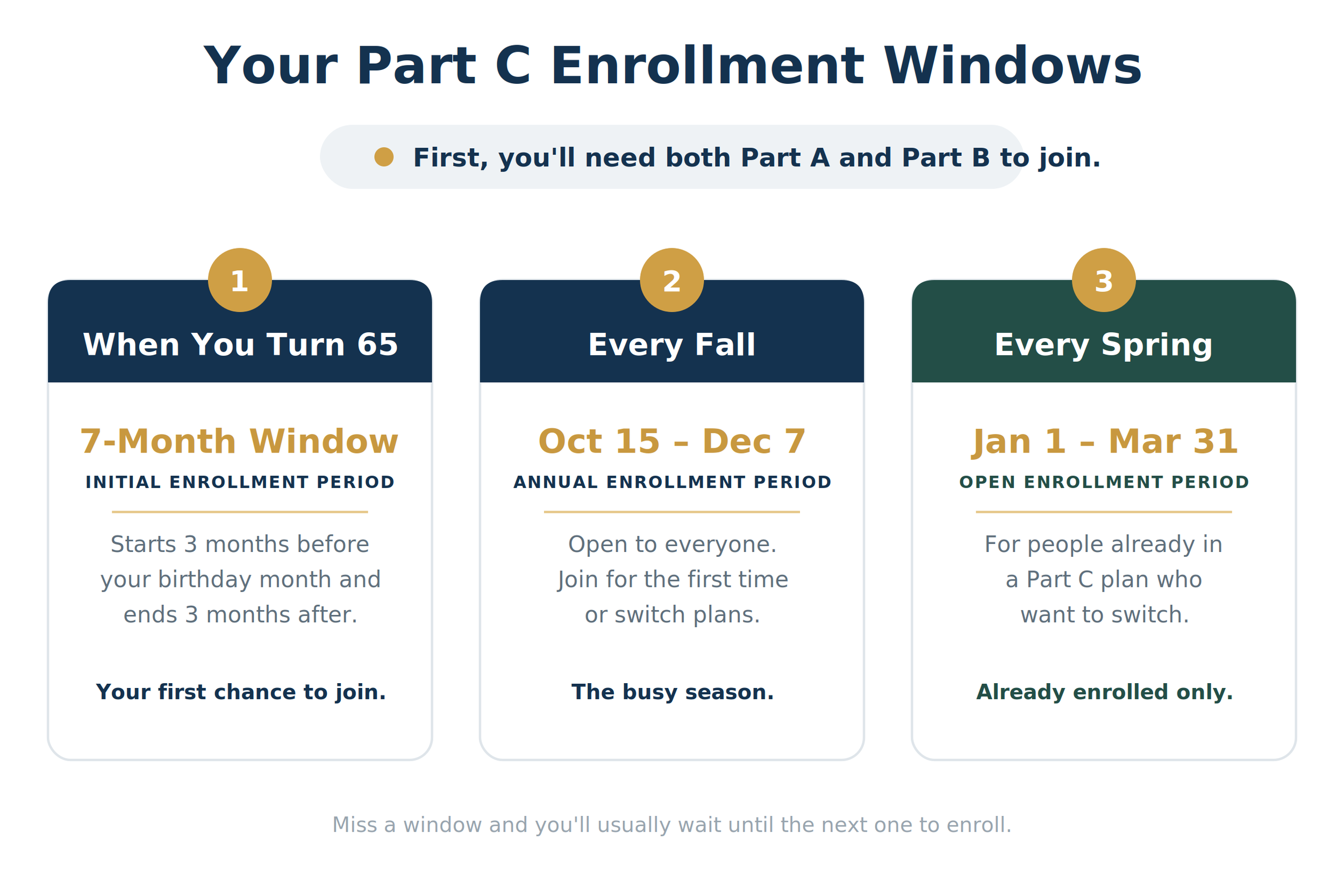
Enrollment: To join a Part C plan, you first need both Part A and Part B. Once you have those, there are three times you can sign up or switch:
When you first turn 65. You get a seven-month window, starting three months before your birthday month and ending three months after.
Every fall, October 15 to December 7. This one is open to everyone, whether you're joining for the first time or changing plans.
Every spring, January 1 to March 31. This one is only for people already in a Part C plan who want to make a change.
What It Costs: Many Part C plans have a low monthly premium. Some charge nothing at all. But a plan that costs nothing still isn't free. You always pay your Part B premium, the one everyone on Medicare pays. You also pay a small amount each time you see a doctor or pick up a prescription. Those add up over the year. So the plan with the lowest premium isn't always the one that costs you the least. We can add up what a plan really costs for a full year, so there are no surprises.
Medicare Part C FAQs
Do I still pay my Part B Premium?
1
Yes. Part C doesn't replace Part B, it delivers it through a private plan. You keep paying your monthly Part B premium, the one everyone on Medicare pays, even if your Part C plan itself costs nothing.
Do I still have Part A and Part B if I choose Part C?
2
Getting started is simple. Reach out through our contact form or schedule a call. I'll walk you through the next steps and answer any questions along the way.
Do I need a separate Part D drug plan?
3
Usually not. Most Part C plans already include your prescription drug coverage. You'd only need a separate Part D plan if you kept Original Medicare instead of choosing Part C.
It can be, but it takes some thought. Part C plans are built around local networks, so they work best where you live. If you're a snowbird or you travel often, a PPO travels better than an HMO, because it still covers out-of-network care at a higher cost. For some frequent travelers another path fits better, and that's exactly the kind of thing worth talking through before you choose.
I spend part of the year in another state. Is Part C right for me?
4
Can I keep my Medigap plan?
5
No. Medigap only works alongside Original Medicare, not Part C. You have to pick one or the other. If you already have a Medigap policy you're happy with, think it through carefully before switching.
Still Have Questions?
Medicare comes with a lot of details, and it's normal to have questions along the way. That's exactly what we're here for. Reach out anytime, whether you're just starting to look into your options or trying to sort out a specific decision. There's no cost to the conversation, and no obligation attached to it.